 Maurice Francis
Australia
Maurice Francis
Australia
- Born
- 1904? in South Africa
- Died
- 1 December 1962 in Australia
- Aged
- 57-58 years
- Credited for
-
story
- Also known as
-
Maurice Francis
- Ausreprints
-
Bibliography
(2 items in database) -
Maurice Francis (1935)

Francis was born in South Africa and came to Australia when he was 10. He was educated at Wesley College in Melbourne.
He worked as a cadet journalist at the Melbourne Herald before spending three years on a family sheep and dairy farm in New Zealand, aged about 22. At the start of the great depression, he drove a sweet wagon, while writing plays for his own benefit. He was drawn to the new medium of radio and became a pioneer of dramatic and serial writing in Australia.
As an unemployed accountant with no radio experience, Francis secured a job with George Edwards and Nell Stirling in mid-1932 to script and act in Ghost Train for broadcast on Christmas night that year on Sydney radio station 2GB.
Francis, George and Nell formed the successful George Edwards Players, creating radio serials soon relayed to other capital cities. In 1935, 2GB reported that George Edwards produced more plays than any other radio producer in Australia (The Wireless Weekly v25#5, 1/2/35).
Francis proved capable of producing scripts very quickly and he understood what the public wanted from radio serials. He would dictate scripts to a relay of four stenographers, while keeping track of each plot.
Original radio scripts and adaptations by Francis during the first year at 2GB include Rasputin (May 1933), Robert Louis Stevenson’s Dr. Jekyll and Mr. Hyde (May 1933), The Gigolo (May 1933), Edward Finnegan’s The Singapore Spider (June 1933), Alexandre Dumas’ The Count of Monte Cristo (June 1933), Undergrowth (July 1933), Mary Shelley’s Frankenstein (July 1933), Deserters of the Legion (July 1933), Victor Hugo’s Hunchback of Notre Dame (August 1933), Robert Service’s poem The Shooting of Dan McGrew (August 1933), The Progress of Mr. Humperdink (September 1933), The Vengeance of Sing Chu (October 1933), Earthquake (November 1933), Warwick, the King-Maker (November 1933), The Mystery of Maltby Manor (November 1933), Scott, of Scotland Yard (serial from before December 1933) , The Fatal Song (December 1933), Lewis Carroll’s Alice in Wonderland (December 1933), Family Problems (serial from December 1933), and The Forbidden Veil (December 1933).
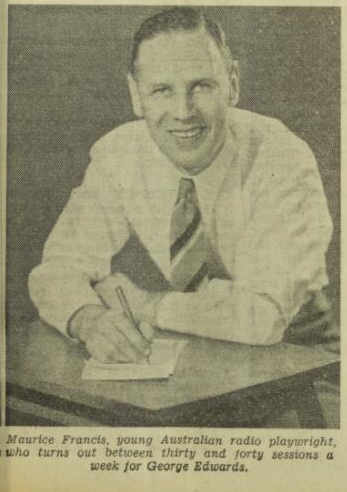
In 1934 The Wireless Weekly reported that Francis was writing 36 scripts a week (v24#9, 31 August 1934), with a claim the following year of 30 and 40 sessions (v26#17, 25 October 1935). He was responsible for most of the scripts for George Edwards Players, although Edwards claimed to provide the plots. Francis mostly stayed in the background, while George and Nell were known and loved by millions.
When Francis was stretched, Edwards secured other writers to help. In 1934, Letty Craydon and Sumner Locke Elliott (Careful He Might Hear You) were engaged to help with scripts.
From May 1936, George Edwards and the team moved from 2GB to 2UW on a five year exclusive contract.
Some popular serials by Francis include Notable British Trials (1935-1940), Martin’s Corner (1939-1950), Inspector Scott of Scotland Yard (1933-1940), The Adventures of David and Dawn with George Edwards in Fairyland (1936-1939), Mittens (a horse racing drama, 1938-1941) and The Laughing Cavalier (1934-1935).
Francis’ most successful serial was Dad and Dave of Snake Gully (1937-1964) which ran five nights a week on about 60 radio stations at its peak. He credited his time farming in New Zealand as background for the success (The Wireless Weekly v30#26, 24/12/37). In contrast, George Edwards credited their tripe through the Australian outback while developing the series. Neither, however, seem to have acknowledged Steele Rudd (On Our Selection).
Francis stayed with George Edwards until he enlisted in the AIF from 1 July 1940. He had lost his father in the first world war and felt that he was taking up the fight for freedom from his father. He reported that he had written enough plays to keep George Edwards Productions busy for months ahead intended to have an enormous amount more written when he returned (The Wireless Weekly v35#29, 20/7/40). Lorna Bingham took over scripting Dad and Dave when Francis left.
In October 1941, while still in the army, Francis moved to the Macquarie Network (2GB) contributing scripts written on leave and in spare hours, in Australia and abroad. The first story was Ivan the Terrible, followed by the ongoing serial First Light Fraser (27 July 1942 - 25 March 1948), the story of ‘a modern Pimpernel’ (played by Richard Ashley) and his female companion Kay Lawrence (Lyndall Barbour) who set out to thwart the Gestapo. Francis later adapted the series for a book (Frank Johnson, 1944) and New Adventure Comics (Frank Johnson, ~1949).
In May 1942, Frances was promoted to Lieutenant.
On return to civilian life, he registered Maurice Francis Productions on 21/5/45 for ‘writing and producing radio scripts’ (Dun's Gazette for NSW v73#24 15/6/45) A few months later, he registered Maurice Francis Productions Pty. Limited (27/8/45) in partnership with Michael B. Isaacs, and co-directors James Russell, Mervyn R. Cleveland and Donald Sharp (Dun's Gazette v74#15, 12/10/45).
In February 1945, his bleak play about a serviceman’s readjustment to civil life, They Never Come Back, was produced. The play was a commercial failure that led to his subsequent bankruptcy, declared in 1946 (The Sun, 17/12/47).
Francis later went into advertising. In 1949, he wrote a special “Health Week Song”, performed by the Sydney New Symphony Orchestra.
He has a strong interest in amateur theatre, helping establish the Temple Emmanuel Dramatic League in 1940. He produced Lillian Heilman’s The Little Foxes for the Mosman Theatre Guild (1945) and for for the new Sydney Playhouse (1949).
In June 52, he directed John Dighton’s The Happiest Days of Your Life in a hall at Double Bay as part of the Woollahra Municipal Council's test of “the feelings of the citizens of the municipality as to the possibility of forming a dramatic society”. He helped establish The Woollahra (Sydney) Playhouse and his play Go West Young Man was presented at the new Woollahra Arts Centre (St Brigid’s, next to Readleaf). He established the Woollahra Theatre for Children in 1953.
During the early 1950s, Francis wrote and directed a number of plays. In Sept 1951 he directed the Liberal Youth Dramatic Club in Noel Langley’s Little Lambs Eat Ivy (Independent Theatre, North Sydney), followed by his own script Present Again in February 1952. His play Here, There and Everywhere (The Independent Theatre, North Sydney) was performed April 1952.
The reviews were often negative, indicating Francis struggled to transition from the ‘quick and dirty’ world of radio scripting.
From 1953, Francis was writing producing independent radio serials acquired by various radio stations, including The Crosby Story (2HR August 1953), Medals for Murders (2UE October 1953), Twin Serpents (2UE November 1953), The Conqueror about William the Conqueror (2UE January 1954), Shadows of Doubt (2GB May 1954), The Sins of the Fathers (2UE, June 1954) and This Your Dream (2UW, August 1954).
Francis and his wife Pat had a daughter Patricia Rose, born around 1926, who occasionally featured in his early radio plays. In 1937 they moved from an apartment in Elizabeth Bay to Roseville (seeking space for a dog). By the time of his death in 1962, Francis was living in Manly. His brother, Cyril Harris, also a script writer during the golden era of radio serials, worked for Dorothy Foster Radio Features, on scripts such as "Bindle" and “Oh, Reggie" (The Wireless Weekly v35#40, 5/10/40, Commercial Broadcasting 15/8/1940).
Francis had two novels published by Horwitz—the first a month before he died (The Snake Gully Mob, 1962) and the second posthumously (The Chairman is a Lady, 1963).
Notes
Key information is from Sydney Morning Herald obituaries (3/12/1962 and 9/12/1962) and issues of The Wireless Weekly. In 1938, Francis reported he was 33; an obituary reports he was 58 when he died. 'Maurice Francis' is probably not his birth name. In response to a question about his 'proper name', The Wireless Weekly v25#11, 15/3/35, replied "Maurice Francis, changed to this legally". According to death records, his father was Ernest Lionel and his mother Jenny (family name not identified). His daughter, Patricia Rose Walmsley of 69 Addison Road Manley, died 23 July 1969; her death notice reports her as granddaughter of Rose Hutchinson of Gogga. There is biography of Francis in Richard Lane's 'The golden age of Australian radio drama, 1923-1960: a history through biography', Melbourne University Press, Carlton South, Vic, 1994.
Ausreprints ID
- 363
Recorded credits
- Australia: 2
Can you help?
- Details may be incomplete. Click here to report updates.