Johnny Galaxy lands in Australia
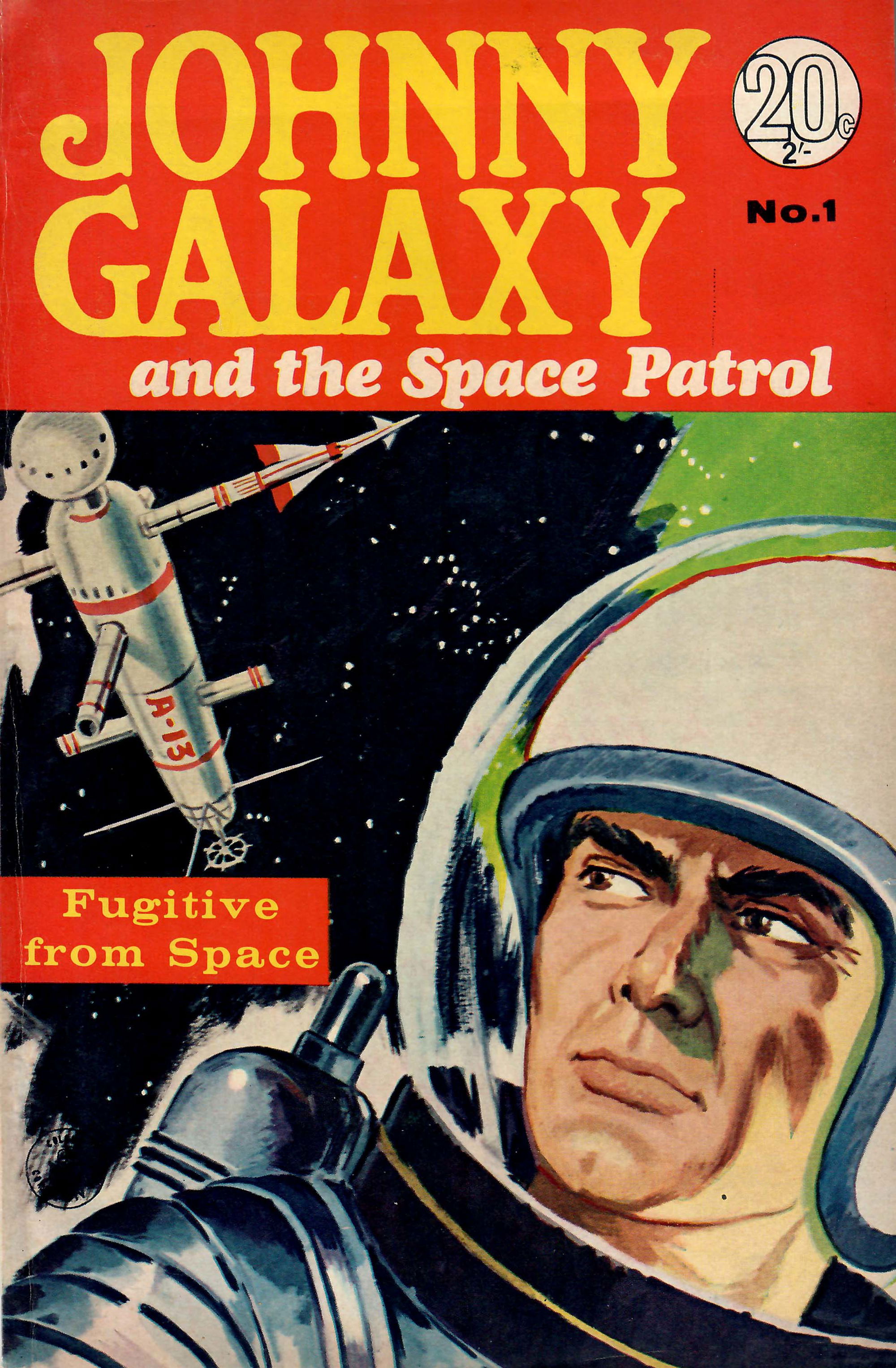
Johnny Galaxy and the Space Patrol was among the earliest work from Spanish agency Selecciones Ilustradas (SI) to be printed by KG Murray.
The feature was first published in Australia in its own title (1967-1968) composed almost entirely of Johnny Galaxy stories. When that series ended with four issues, the feature moved to Climax Adventure Comic (1968–1973) and finally Super Giant (1973), anthologies that hosted work from a wide array of sources.1
![Johnny Galaxy and the Space Patrol #2 ([ 1967?])](https://images.ausreprints.net/page/8816.jpg "Johnny Galaxy and the Space Patrol #2 ([ 1967?])")
The Australian series has striking pulp-inspired covers2 that were also printed internationally and probably acquired as part of the Johnny Galaxy package.3 However, these anonymous paintings do not depict Johnny Galaxy; rather it is a generic astronaut in a different space suit for each image.
The seven-page Johnny Galaxy stories evoke the atmosphere of DC's 1960s Adam Strange stories, with a threat quickly introduced that Johnny overcomes by wit and bravery, often accidentally aided by his companions. Many episodes are numbered,4 suggesting a publication order, but they largely lack continuity and are not printed in order. Johnny's profession, associates and base of operations are fluid.
![Johnny Galaxy and the Space Patrol #3 ([February 1968?])](https://images.ausreprints.net/page/14405.jpg "Johnny Galaxy and the Space Patrol #3 ([February 1968?])")
Johnny's origin begins on Earth, where he is a bored forest ranger in the Rockies dreaming of being a space pilot. He encounters a dying alien from Altair who passes on his advanced spaceship and a memory-transferring helmet.5 Within a few episodes, Johnny has a headquarters, his outfit is a uniform (with a distinctive triangular emblem) and he associates with an investigative Earth agency, the Space Patrol6 or Space Security.7
Johnny soon gains a young "co-pilot", a Sirion boy called Truck.8 Most stories show Johnny and Truck stumbling across crises or responding to distress calls that lead to adventures. Some stories show Johnny as a solo explorer, which may occur after Truck's parents tell him he must "stay home".9
![Climax Adventure Comic #7 ([November 1968?])](https://images.ausreprints.net/page/16766.jpg "Climax Adventure Comic #7 ([November 1968?])")
Johnny Galaxy was created as Johnny Galaxia by Josep M. Beá10 (b. 1942) and Blay Navarro11 (b. ?) for Spanish agency Selecciones Illustradas (SI) in 1959. It was quickly sold to the UK, but became one of the first SI works to recieve multiple international printings,12 rather than being owned exclusively by a single publisher. The series received broad publication across the globe in the early to mid-1960s, with its introduction into Australia comparatively late.
This early experimentation with syndication13 may account for the variability in the feature's plotting, artwork and even naming—with the title ranging from Johnny Galaxy, Johnny Galaxia and Johnny Galaxie to the unpredictable Space Ace and Alan Ford.