Epilogue and afterword
At the end of the second world war, the NSW Bookstall experiment with comics was over and publishing activity at the firm ceased. I've seen references to books from the 1950s, but the latest new book I've confirmed is John Moyes' Mighty Midgets (with a cover by Brodie Mack), published 1946.
Around the start of 1946, Paul Dowling gave a dire assessment of the state of the publishing industry, arguing for tarriff protection: "Due to the small population there is a limit to what successful production can be accomplished in Australia. War-time sales were abnormal and should not be taken as a criterion of post-war conditions.1
While some of the comics are generally dated up 1945, there are no dates on the comics and no detail on how those dates have been estimated. I've tried to draw conclusions from the data I have, but the results are inconsistent. It is possible the series had a more compressed timeline.
![Australian Comics for Australians [1943?]](https://images.ausreprints.net/gallery/1238.jpg "Australian Comics for Australians [1943?]")
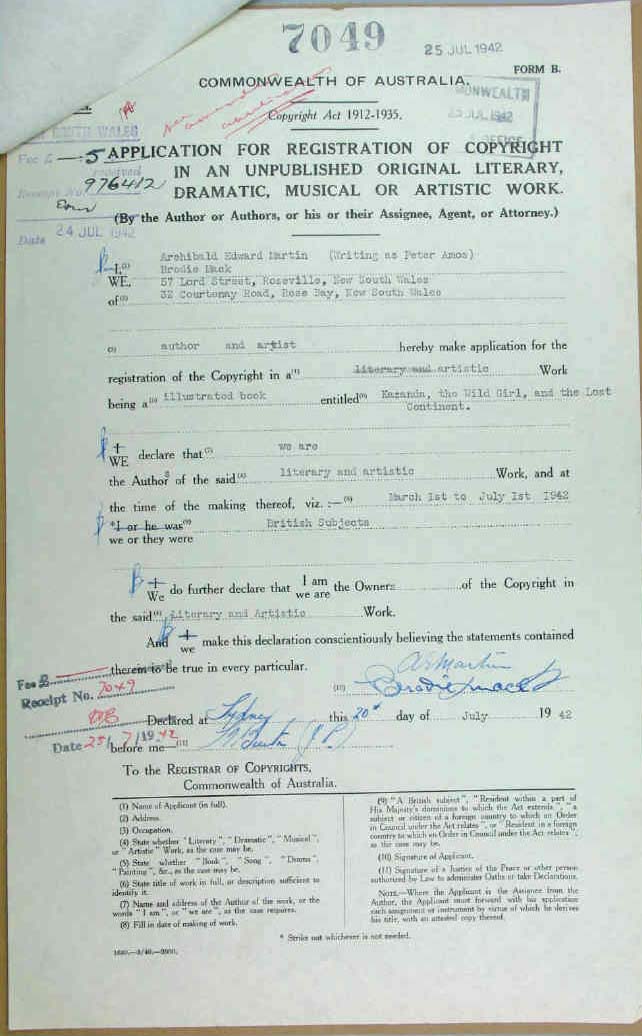
The two issues with relatively firm dates are Jimmy Rodney on Secret Service in late 19402 and Kazanda the Wild-Girl and the Lost Continent prior to July 1942.3
Based on advertising on the back cover of that issue of Kazanda, 16 Bookstall comics were available at that time, and Jimmy Rodney is not included on the list. One of the books included on that list, The Commandos, has a matching shorter list of 12 back issues, suggesting an earlier date. Overall, those advertisements point to an average of about one comic published month.
If those advertisements suggest a publication order, Trapped would have been published between the two issues in early 1942, as it is in one advertisement and not the other. However, the advertisement on the back of Trapped has a more extensive list of 23 back issues (including itself, but not Jimmy Rodney).
![Obtainable at all Newsagents [NSW Bookstall]](https://images.ausreprints.net/gallery/1241.jpg "Obtainable at all Newsagents [NSW Bookstall]")
The most likely conclusion is that NSW Bookstall kept the comics in print with updated back issue advertisements, like Classics Illustrated—or the earlier Bookstall Series of novels that delivered profits through low-priced high-volume sales, with any popular items reprint.
Based on this limited information, it looks like the comics extended only to 1944. At that time, comics from other Australia publishers flooded onto the market providing NSW Bookstall with an easier source of product for its shelves.
Carol Mills reports "The Company lasted until 1957, latterly under the direction of Rowlandson's son, who did not demonstrate his father's flair for business, although by the time he was old enough to manage the firm its direction had changed under the managers appointed by the executors of Rowlandson's will."4
![Australian Comics for Australians [1944?]](https://images.ausreprints.net/gallery/254.jpg "Australian Comics for Australians [1944?]")
Colin Rowlandson became a Director sometime before 1934.5 He became Managing Director when Paul Dowling retired in 1956. At the time of his death on 25 November 1957, he was described as Chairman and Managing Director of the company.
During the company's final 15 years, it remained a major bookseller, not a publisher. It is noted for providing subscriptions to overseas periodicals6 and for its Bookstall Library, with a spacious reading lounge for subscribers, in the basement of its store at Market and Castlereagh Streets. This provided low-cost book loans, with extra books available for country members.7
Around the time of Rowlandson's death, NSW Bookstall ceased to exist.8 The company was put into into voluntary liquidation in 1958 and the final accounts were presented by W.J. Basden, Liquidator, on 5 September 1960.9