Building a publishing empire
![The Cards of Fortune [nn] (1922)](https://images.ausreprints.net/page/84174.jpg "The Cards of Fortune [nn] (1922)")
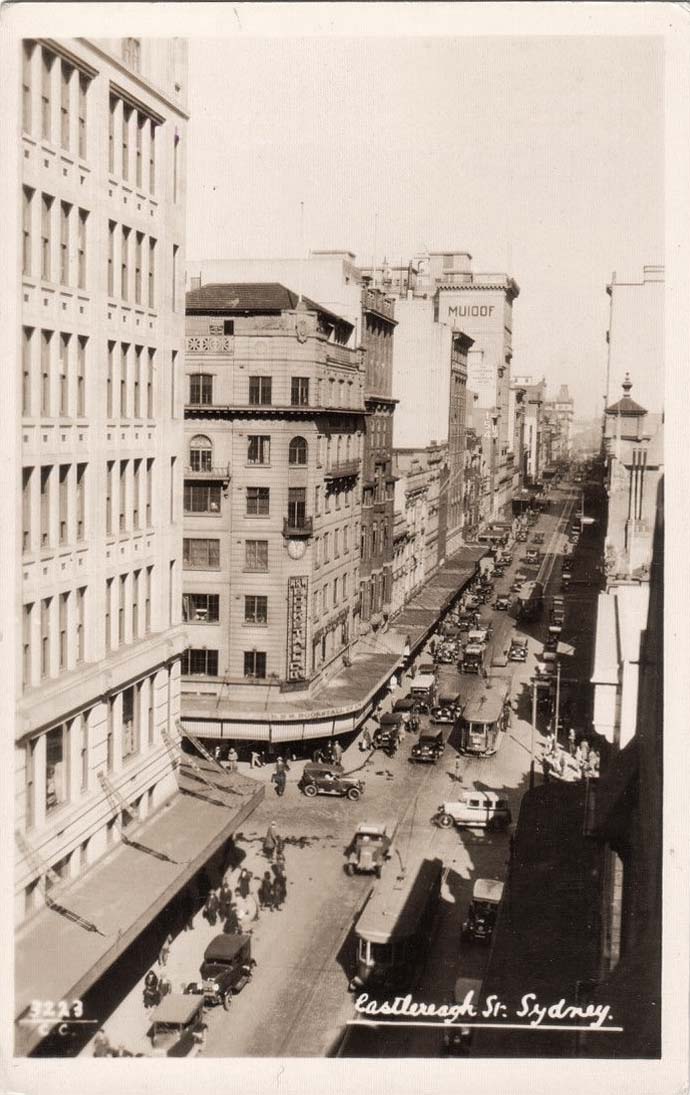
Rowlandson broadened his company's bookselling network, building a chain of eight well-appointed shops and some fifty quality bookstalls at ferry wharves, tram stops and railway platforms.1 But it was his passion for original Australian books turned the company into a national institution. He believed that Australians wanted to read Australian authors telling stories about Australia and created the largest and most prosperous publishing business in the country.2
With a ready-made distribution network, Rowlandson was well placed to expand into publishing. His focus was not respectable literature, but quick leisure reading for a boring train or ferry journey. He created local product at an affordable price that could compete with overseas publications on his bookstalls.
His initial endeavours tapped into the patriotic fervour around federation in 1900 and were well suited to impulse sales at railway bookstalls. An extensive range of postcards3 and small illustrated souvenir books focused on Australian imagery. Commemorative albums tapped into interest in visiting cricket tours and Australian involvement in the Boer War.
![Sydney Past and Present [nn] (1902)](https://images.ausreprints.net/page/84131.jpg "Sydney Past and Present [nn] (1902)")
It was The Commonwealth Annual on Australian art and literature in 1901 and 1902 that foreshadowed a coming revolution. These included stories by Arthur Davis, known nationally as Steele Rudd, the icon creator of 'Dad & Dave' and author of On Our Selection. The annuals included most of what later became Sandy's Selection.
In 1904, Rowlandson acquired the rights to Sandy's Selection for a previously unheard of £500 advance with further royalties if NSW Bookstall made a profit.4 It was a gamble—two previous Steele Rudd books had sold well at the standard three- and six-shilling book prices, but that was no guarantee of the 10,000 sales needed to cover the costs of the 'shilling books'.5 Yet within a month of publication, over 40,000 copies had sold.
While he used a big-name attraction to launch his new 'Bookstall Series', Rowlandson's passion was new authors and artists. He put his money behind creating market opportunities for writers and expanded the Australian industry. He also published women writers and argued their work was equal to men's. More than twenty of his books were turned into contemporary silent films and some remain in print today.
![36 Views [nn] ([1904?])](https://images.ausreprints.net/page/84130.jpg "36 Views [nn] ([1904?])")
Rowlandson pioneered the use in Australia of art to promote sales. All the books had colourful covers and interior illustrations by local artists. Contributors included renowned artist Norman Lindsay (as well as Lionel, Percy and Ruby Lindsay) and political cartoonist David Low before achieving fame in the UK. Other Bookstall illustrators were Will Dyson, Harry Julius, Fred Leist, Vernon Lorimer, Claude Marquet, Charles Nuttall, Sydney Ure Smith, David Henry Souter, Percy Spence and Alf Vincent—most of whom found careers illustrating for newspaper.
Others had produced cheap Australian paperbacks, but this was the first ongoing program of mass-produced disposable books. They were down-market, akin to the US dime novels and UK shilling shockers, but lacking the more controversial genres. At around 50,000 words, the books tended to be twice as long and were submitted by name authors, rather than following the pulp tradition of a stable writers churning out serial work under pseudonyms.
Rowlandson's success has been credited to his courage, perseverance, business judgment, active advertising, cheap production and determination to keep the price at one shilling. Over time, thousands of shops across Australia and New Zealand stocked the books as reliable sellers, achieving the necessary high-volume sales despite a scattered Australian population of just five million.
![Official Souvenir of the Wallabies British & American Tour Season 1908-9 [nn] ([1909?])](https://images.ausreprints.net/page/84185.jpg "Official Souvenir of the Wallabies British & American Tour Season 1908-9 [nn] ([1909?])")
In total, Rowlandson published some 200 novels in the Bookstall series and a total of over three hundred titles, running to over nine hundred editions and reprints—often almost single-handedly whilst carrying on other business ventures. He considered it a matter of giving the public what it wanted; he was just a link between Australian authors and their readers.6 His influence was reflected in imitations, such as The Commonwealth Series from Angus and Robertson beginning as early as 1905.
In 1922, the hard working Rowlandson travelled overseas7 on medical advice that he rest. He was unable to complete the holiday to the US and Canada, and returned on the same ship from San Francisco. He died in New Zealand in transit, following an operation for appendicitis.8
Rowlandson bequeathed his estate to his widow, children and adopted daughter, and NSW Bookstall suffered a prolonged period of probate.9 His wife Alma Rebecca Rowlandson (1869-1925) died a few years later on 2 April 1925 and his son Colin (Bill) Rudgland Rowlandson (1910-1957) was a minor, unable to take control of the firm.10
Rowlandson's successor was as Managing Director was Reginald Wynn, son-in-law of founder Henry Lloyd11 and a part of the company since 1995.12 On a trip to the US, Wynn contracted 'a severe attack of influenza' and died on 18 December 1925, soon after his return to Australia.
The next Managing Director, Mr James Simpson, an accountant and once of Rowlandson's executors. He was in the position just a few years, around 1926 and 1927.13 The company languished without strong leadership for a decade. Some publishing operations continued initially, but the last of the Bookstall Series was released in 1928 (Arthur Wright's A Good Revovery) and the firm's focus returned to bookstalls and retail.
From 1929 to 1946, just 48 new book titles were published. This includes a brief series of cheap 2/6 hardbacks reusing the company's States Publishing Company imprint, Rowlandson's 1905 experiment with more expensive hardbacks at the time he was creating the Bookstall Series.14
In June 1929, Mr William Augustus Crew (1876-1954), a member of the firm for 39 years, became General Manager15 and the company's operations were controlled by three Trustee Directors: brothers Paul Dowling and Brendan Dowling, accountants, and Mr R C Tobin. Mr Tobin was a solicitor for the estate's trustees (R.M. Shorter and Tobin Solicitors).16
While Paul is the most prominent of these Directors and referred to as Managing Director in contemporary reports, Brendan initiated the company's next important phase.