 Kick
Australia
Kick
Australia
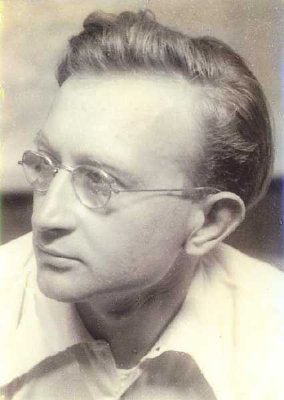
- Born
- 29 March 1907 in Netherlands
- Died
- 4 August 1965 in Australia
- Aged
- 58 years
- Credited for
-
art
colours
letters
story
- Also known as
-
Jan Pieter Lodewijk Kickhefer
Hofer (pen name)
J.P.L. Kickhefer (pen name)
Jan Kickhefer (common alternative)
Kick Heffer (pen name)
Kick Hofer (pen name)
- Ausreprints
-
Bibliography
(95 items in database) -
Jan Kickhefer (Kick) (1940?–1950?)

Following his parents' divorce and subsequent death of his father, Kick left school aged 14 years and sold newspapers on the streets to earn money. At 17 he started work in a print shop and completed school by attending evening classes. He lived with a friend's family in Bloemendaal and drew political cartoons for De Notenkraker and Het Volk.
He began work at Philips in September 1929 in the 'Artistieke Propaganda' department. He drew at least four covers for Phillips Bulletin and designed many posters, advertising brochures and advertisements. At this time, he met his future wife Betty Huismans.
Shortly after April 1932, during economic recession, Kick was fired for communist sympathies. He moved to Amsterdam and worked for De la Mar advertising agency. Following a holiday in Moscow, he decided communism was as dangerous as fascism. He married Betty and accepted a three year contract to work for De la Mar in Batavia. In December 1932, the couple left for the Dutch East Indies.
In Batavia, Kick illustrated several covers for De la Mar's magazine Meer Baet. Ultimately, he bought out the last year of his contract and traveled to Japan and China. Many of his drawings from the trip were later published by Het Volk in Amsterdam.
Around 1935, Kick became a partner in an advertising agency that ultimately closed and then worked for Bataviaasch Nieuwsblad doing political drawings under the pseudonym Hofer. Two books were published with a selection of his work.
Following the 7 December 1941 attack on Pearl Harbour, Kick joined the army. He drew propaganda for the Allies in Bandung and was imprisoned when the Japanese invaded. After the war in 1945, he was reunited with his wife and daughter in Ambarawa where they had been interned. Throughout the war, Kick drew images of life in the camps and later of a Denpasar (Bali) peace conference.
In 1948, Kick's family emigrated to Australia and settled in Sydney. He worked for Associated Newspapers as an illustrator for The Sun (1949-1953), also providing illustrations for The Bulletin and World's News. In 1955 he joined Australian Consolidated Press, drawing for The Australian Women's Weekly (including the cover of the Christmas edition 28 December 1955) and Chuckler's Weekly.
In the mid-1950s, Kick illustrated books for Angus and Robertson about the Second World War in the Pacific, based on his experience during and after the war. He is also reported to have drawn for The Sydney Morning Herald and The Telegraph.
He was diagnosed with multiple sclerosis in 1960 and progressively lost his ability to draw, although his art appeared in The Australian Women's Weekly until as late as July 1964. His wife resigned from her job at the Dutch Consulate General in Sydney to look after him in his final years. Most of the illustrations Kick did of the Japanese internment camps were donated to the Education Museum in the Hague, The Netherlands, by his wife.
Notes
Kick is incorrectly credited in "Soldier Surgeon in Malaya" as "P.J.L. Kickhefer".
Ausreprints ID
- 340
Recorded credits
- Australia: 95
Can you help?
- Details may be incomplete. Click here to report updates.