Articles
In-depth articles about the history of Australian comics and reprints.
2 November 2022
Vintage Spinner Rack
by James Zee
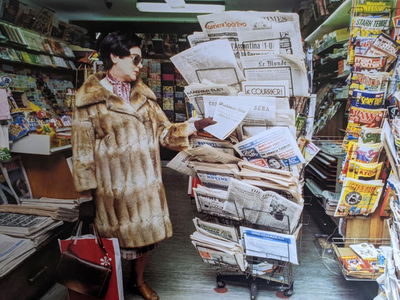
An image sourced from the National Archives of Australia shows a woman in an unidentified Melbourne newsagent. Next to her is a rack with comics on sale.
Based on the available issues, this was probably April 1978.
Here's what's been identified on the racks.
29 October 2022
Hopalong Cassidy (remixed)
by James
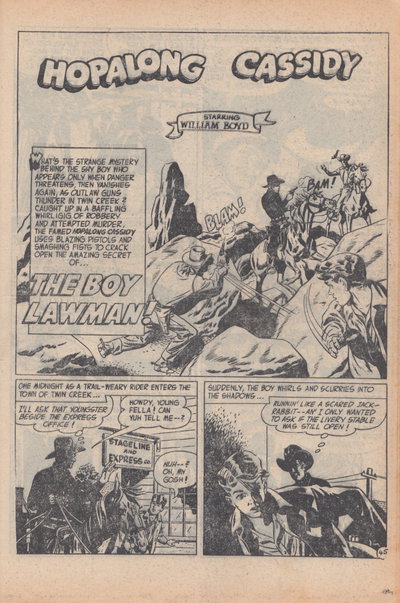
Through the 1950s, Hopalong Cassidy was all the rage in Australia. Perhaps even more than in the US. And for longer.
From 1948, Larry Cleland and then KG Murray reprinted the Fawcett and DC comic series. When DC stopped producing new Hopalong stories in 1959, Murray's dedicated title also ceased, but Hopalong Cassidy stories continued to appear in other KGM titles.
During this period, many DC western characters found themselves magically transformed into Hopalong Cassidy during their travels from the US to Australia.
12 September 2022
Moira Bertram in Armidale
by James Zee
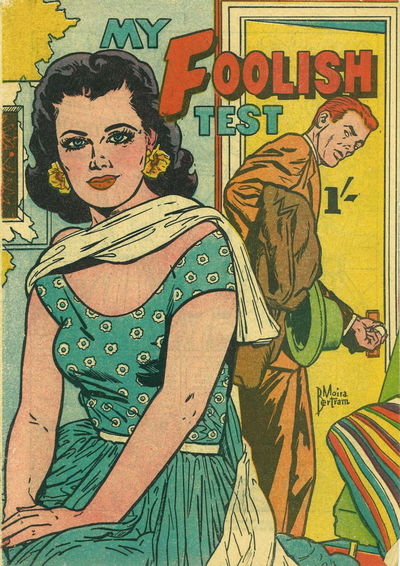
Moira Bertram (1913-1993) was one of the few Australian women working in comics during the peak period of the 1940s and 1950s, writing and drawing with a unique style and creative flair. She worked consistently in partnership with her older sister Kathleen Bertram (1909-1977), who provided the stories' distinctive lettering.
It's not clear when the sisters moved from Sydney to rural NSW. In 1928, Moira was in Tamworth sending art to the Sydney Sun's Sunbeams supplement, but it wasn't published. 'Pehaps your drawings were not quite up to the standard,' Sunbeams said.
11 July 2019
'Irreverent Comments' Revisited
by James Zee
15 March 2018
Topix announced
by James Zee
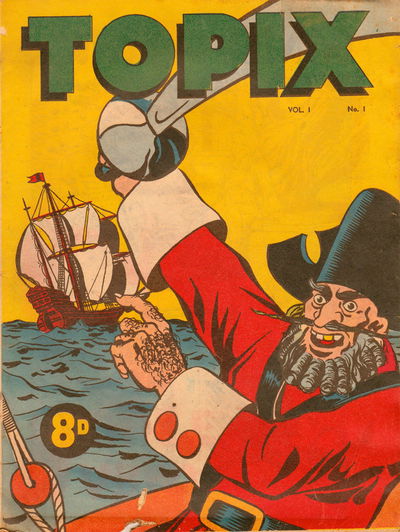
A brand-new wholesome comic book hit the stands in early 1954, according to Sydney's Catholic Weekly on 11 February 1954 and Melbourne's Catholic Advocate on 25 February 1954. This is a product of its time, battling against the threat of comic books during the moral panic and censorship of the 1950s.
Topix was, the papers insist, a decent answer to the other rubbish on the bookshelves, with artwork of the highest quality and absorbing interest. "It's purpose is fivefold":
1 October 2017
Who is Terry Powis?
by James Zee
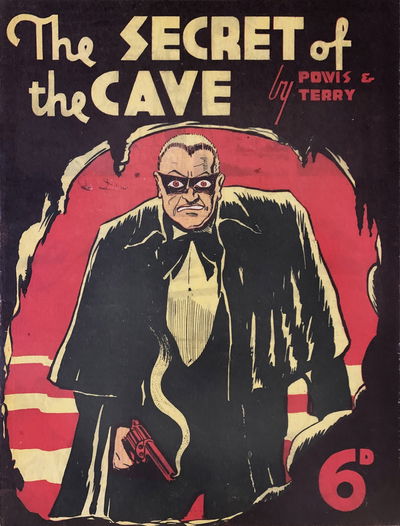
Terry Powis is credited with nearly half of the comics published by the NSW Bookstall Company when it established its ground-breaking line of Australian comics. Yet there is virtually no information about him.
John Ryan in Panel by Panel acknowledges Powis and Will Donald as 'real pioneers of Australian comic books', before largely dismissing Powis' work:
16 September 2017
NSW Bookstall
by James Zee
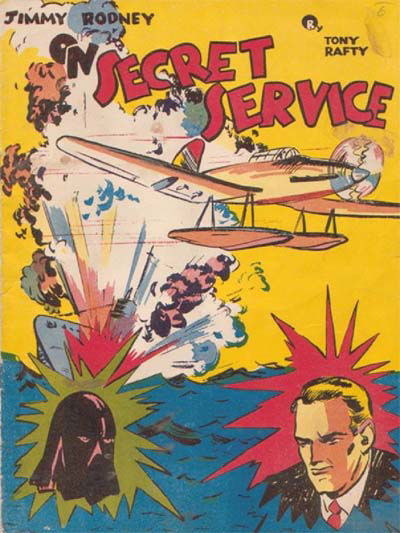
For a few years from 1940, the long-running NSW Bookstall Company engaged local artists to establish the first distinctive line of Australian comics, including some creators who would continue to produce comics and cartoons for many decades—especially Noel Cook and Brodie Mack.
It was probably in 1879 that Henry Lloyd (1847-1897) gained the rights to run bookstalls at train and ferry stations in NSW, established the N.S.W. Railway Bookstall Company, and modernised an operation previously focused on ticket sales.
3 September 2017
1949 political propaganda
by James Zee
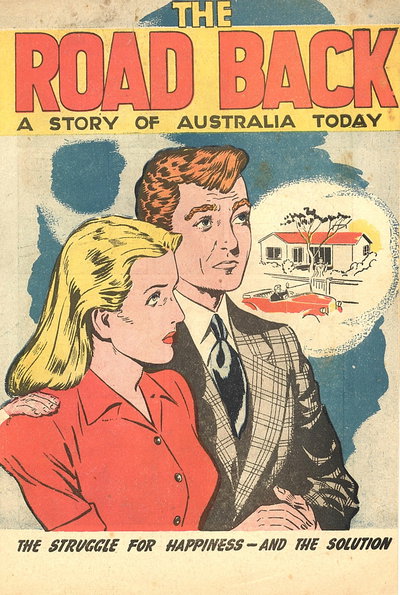
Thanks to a generous contributor, AusReprints has a full scan of The Road Back—political propaganda in comic form. The comic is undated, but released ahead of the 10 December 1949 Australian federal election when Labor lost power to a new Liberal Menzies government. It's clearly original work, but it isn't in the common lists of Australian comics and there are no credits in the issue.
John Ryan in Panel by Panel (p. 141) provides some information, but the way he describes the comics' origins is probably misleading. He reports:
17 June 2017
Listing NSW publishers
by James Zee
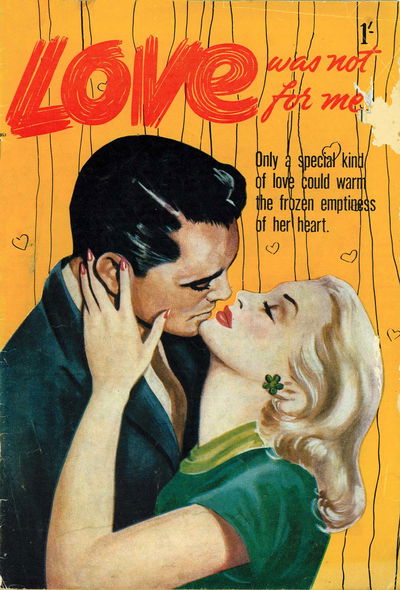
Censorship laws created a list of comic publishers in NSW between 1955 (when the Government substantially amended the Obscene and Indecent Publications Act) and the start of the 1970s (when the law was again reshaped).
The early 1950s saw restrictions on popular literature, driven by a mix of moral panic, international trends, cultural protectionism and vested corporate interests. At the opening of NSW Parliament in August 1954, the Governor told the legislators that “present legislation relating to the control of obscene and indecent publications is considered…inadequate and a measure to enable publications of this nature to be dealt with more effectively will be submitted to you.”
20 August 2015
Nothing New
by James Zee
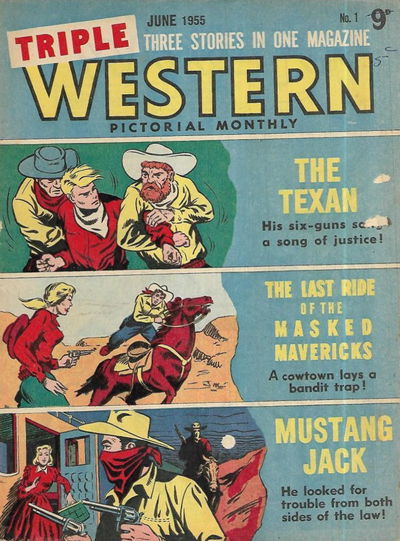
While there are many local creations on the front of US reprints in Australia, the cover design of Magazine Management’s Triple Western and Triple Adventure stood out to me as unique.
As the name suggests, Triple Western (The Red Circle Press, 1955-1957, 21 issues) and Triple Adventure (Approved Publications, 1957-1958, 5 issues) included (most of the time) three stories.
16 August 2015
Does it exist? Pt 2
by James Zee
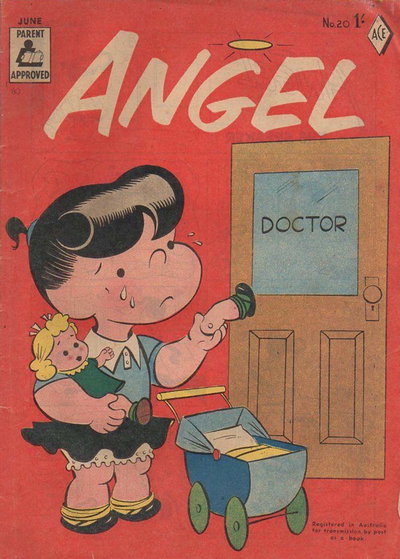
Some Australian publishers started series at random numbers, but the first issue of a Magazine Management title was typically #1. Despite that, a few of its series mysteriously lack low numbered issues and probably don’t start at #1.
Two titles stand out: Angel and Daffy.
13 December 2014
Aus via Italy
by James Zee
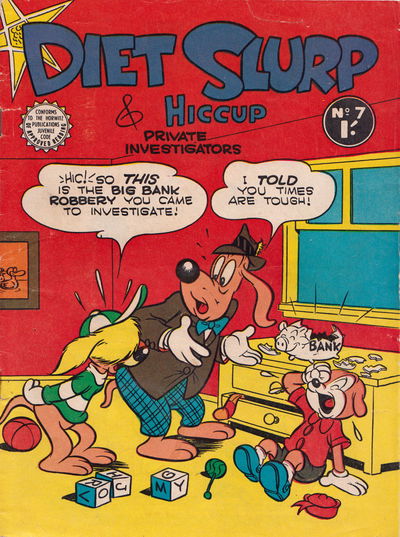
In August I purchased , mainly because I can't resist a mystery. I hadn't come across the series and didn't recognise the featured characters.
It turns out the comic has one Diet Slurp story, with the rest composed of reprints from US Quality's >Feature Comics (Perky) and Modern Comics (Will Bragg) that were a decade old even when this issue was published. But the source of the lead feature remained unidentified.
7 November 2014
Chucklers did that?
by James Zee
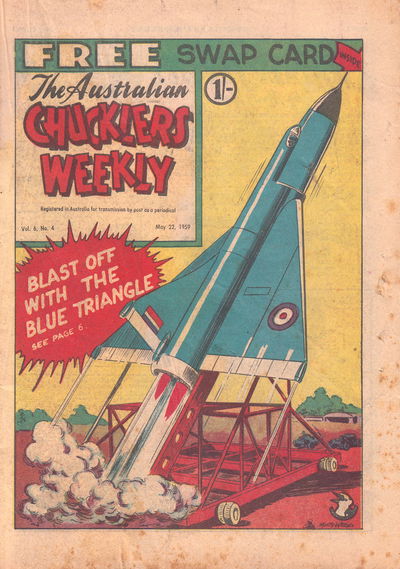
There’s a surprising wealth of international work in Australian comics, despite the dominance of US reprints—including one series reported as never published in English.
That feature was “The Blue Triangle featuring Dan Cooper”, which appeared two pages per week in The Australian Chucklers’ Weekly from v5#39 (23 January 1959) until about v6#30.
17 September 2014
30,000 Aus comics
by James Zee
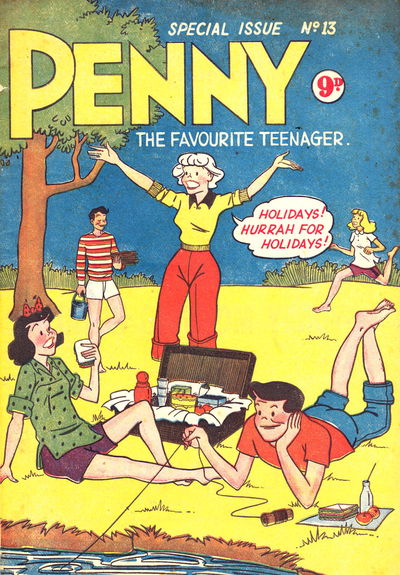
AusReprints has reached a landmark 30,000 Australian issues, both reprints and original work.
The comic that tipped it over the threshhold was Penny the Favourite Teenager #13 from Young's Merchandising Company. And it's an unexpected comic worth highlighting.
5 April 2014
Twice Approved
by James Zee
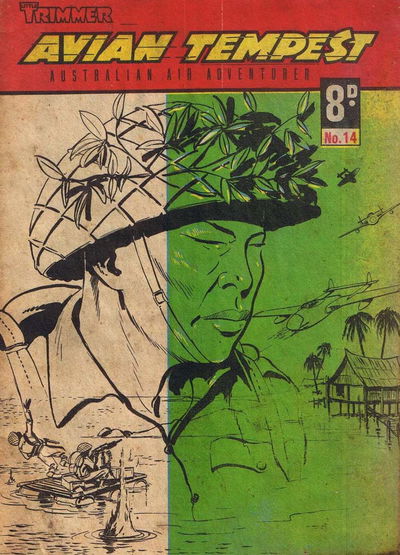
I've been puzzled by the publisher of the rare Australian series Little Trimmer Comic, but I've not seen a copy until recently.
It's one of those situations where I've wondered if respected Australian comics' historian John Ryan 'got it wrong'.
16 March 2014
Does it exist? Pt 1
by James Zee
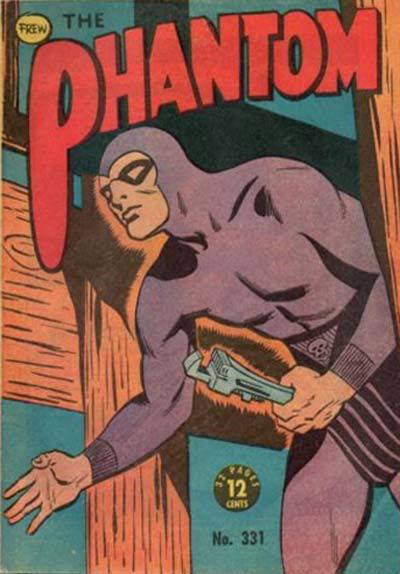
There are a few Australian comics that collectors look for that, most likely, were never published.
One well-documented case is The Phantom (Frew, 1948 series) #330 from 1966. The artwork was irretrievably damaged prior to printing and the following issue (#331) was brought forward to fill the gap. However, due to an oversight, the issue numbering was not updated, leaving a gap (although there was no break in publication).
9 March 2014
Possible AusOriginal
by James Zee
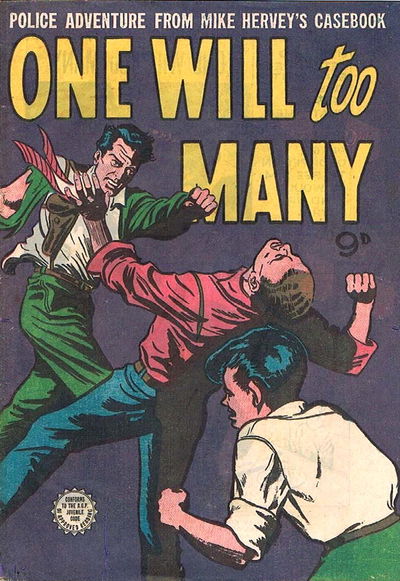
Despite Mick Stone's disclaimer of "likely omissions", it's rare to find a comic by Australian creators missing from his checklist of Australian comics.
One possible addition to the index is , a mystery one-shot comic without creator credits. The title story, which takes up the entire issue, is not reprinted from a typical US source.
26 February 2014
Dating OPC
by James Zee
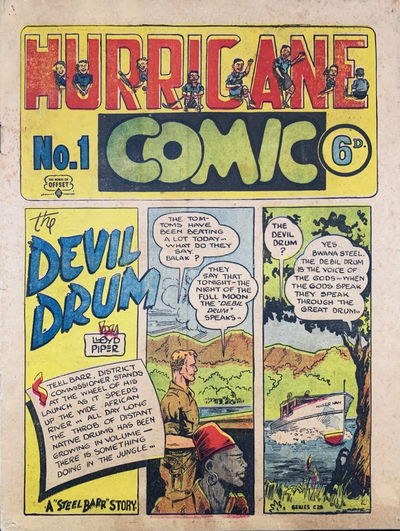
Most Australian comics from the Second World War are undated one-shots, making it challenging to know exactly when they were published. Sometimes it isn't even possible to be sure of the year of publication.
Comics from the Offset Printing Company (OPC) are a classic example. Most suggestions for dates seem to resort to a generic year in the early to mid 1940s.
11 February 2014
Renovation Time
by James Zee
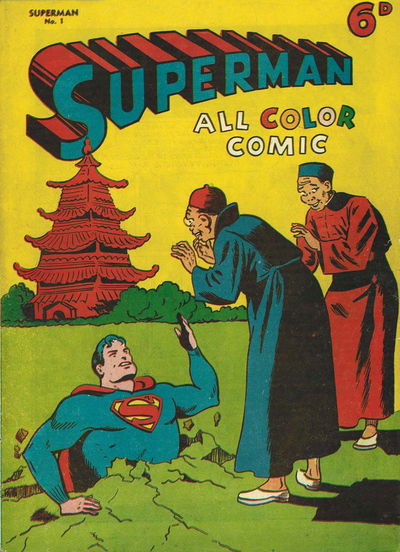
AusReprints turned ten last year and it's time for an overhaul.
I'm receiving increasing reports of site errors. I appreciate it, since I frequently use the database off-line and don't see problems on the site. Most errors can be quickly fixed, but the real problem is that AusReprints has much the same technology as it did a decade ago.
27 April 2013
H. John Edwards
by James Zee
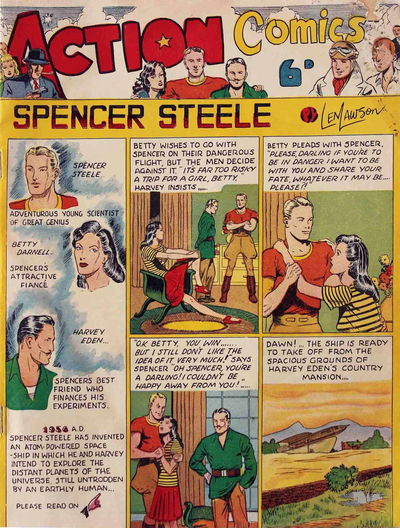
While many Australian publishers disguised the international origins of their comics, H. John Edwards reprints were branded with the logos of US companies such as Fiction House, Standard and MLJ Magazines (Archie).
He also published a large line of original Australian comics with art by some of this country's most accomplished artists, including Larry Horak, John Dixon and Jeff Wilkinson.
15 October 2012
Australian DC reprints
by James Zee
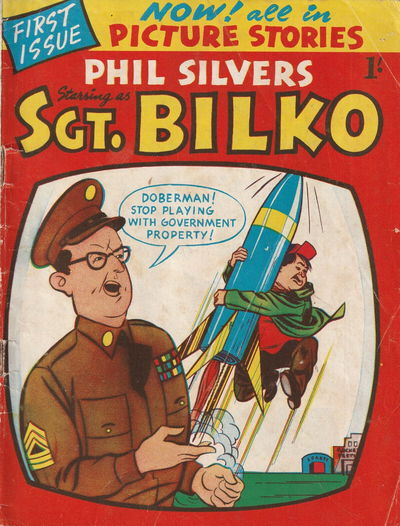
KG Murray (and later Federal) published DC comics in Australia, didn't they?
Well yes... mostly. I've just struck a DC series published by another Australian company, which reminds me that some DC series ended up in the hands of other Australian publishers.
4 October 2012
Puzzling censorship
by James Zee
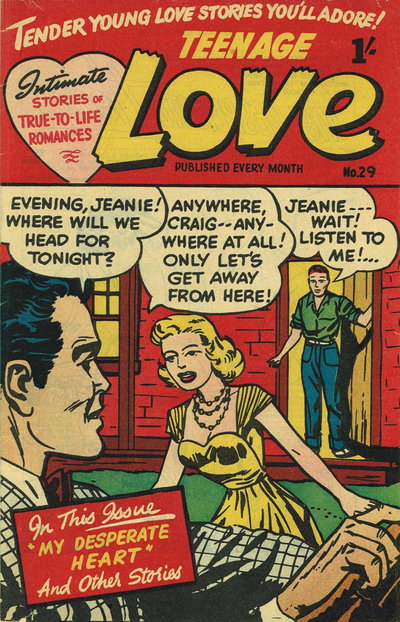
Here's a puzzle about an unedited "sexy" Australian reprint at a time when the contempory US printing was edited—presumably to comply with the Comics Code Authority.
The story in question is "My Rebellious Heart" from Teenage Love #29 (Barmor Publications), which probably dates from 1954. As with many Australian comics this issue is undated, but some recently auctioned Harvey file copies of earlier issues have dates stamped on the cover.
1 July 2012
KG Murray archives
by James Zee
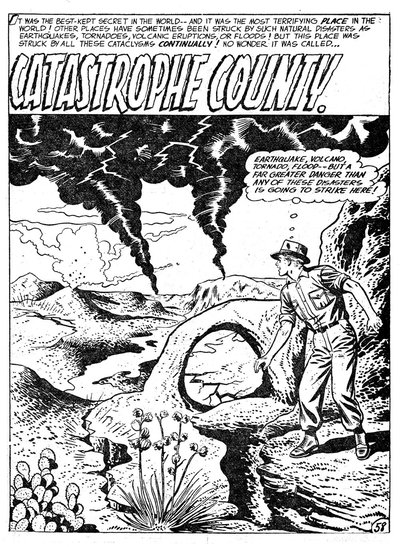
KG Murray's re-use of stories from Five-Score Comic Monthly #10, February 1959 suggests an extraordinary archive must have once existed at the company's headquarters.
The story 'Catastrophe County.' (note the full stop) is a reprint of 'Catastrophe County, U.S.A.' from Strange Adventures #63, December 1955. Such localisation was common at the time: 'Million Pound Ticket', a Mr. District Attorney story in the same issue, was originally 'Million Dollar Ticket'.
30 June 2012
No publisher printed
by James Zee
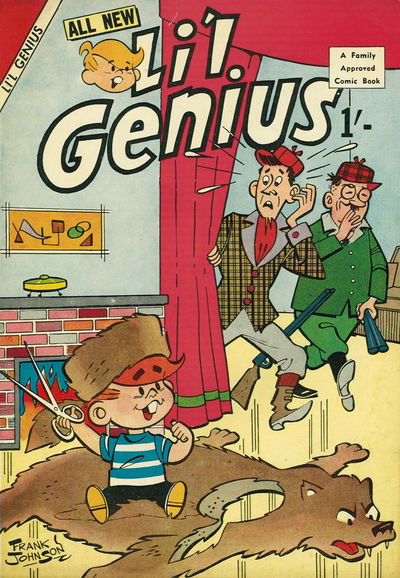
It's rare for an Australian comic to have no publisher listed. An unnumbered, undated issue of Li'l Genius is one of the few I've seen.
The comic probably dates from 1958/1959 or into the early 1960s. Its cover is from Charlton's Li'l Genius #9 (1955)—and probably the contents also, but I can't find information to be sure.
3 October 2011
Disney
by James Zee
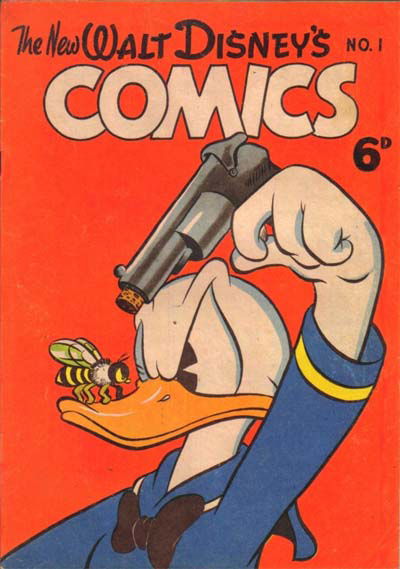
Between 1946 and 1978, Australian Disney comics were continuously produced by W.G. Publications (renamed Wogan Publications in 1974)—although other companies published some Disney comics for Australia before, during and after that time.
John Sands published a few Disney comics in the 1930s, with a handful more by Ayers & James in the 1940s. The Australian Woman's Weekly also published at least one in the 1940s, with free promotional comics from Nabisco (Wheaties) in the 1950s and Mobil in 1964.